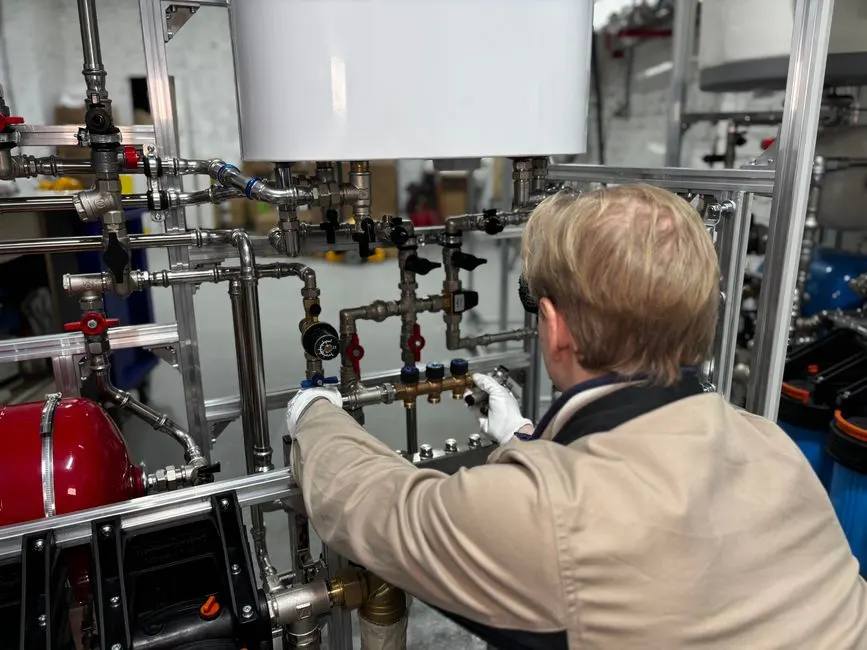
Your water heater keeps running out of hot water because the tank is losing its ability to heat and store water - usually from sediment buildup, a failed dip tube, undersized capacity, or a burned-out heating element. In Hinesville, where our water runs hard with dissolved minerals, sediment is the culprit in roughly half the calls we run. The rest break down into a handful of predictable failures, and almost all of them are fixable without tearing out the whole system. Below we walk through each cause, what it sounds and looks like, and what it costs to fix in 2026.
Why does my water heater keep running out of hot water in Hinesville?
Why does my water heater keep running out of hot water Hinesville is a question we hear almost every week, and the answer almost always comes down to one of six things: sediment, a broken dip tube, an undersized tank, a failing heating element, a thermostat that has drifted, or a tankless unit that is being asked to do more than it can. Each one has a different fix and a different price tag.
The first thing to understand is that a water heater running out of hot water is not a single problem - it is a symptom. A 50-gallon tank that used to give you a 20-minute shower and now gives you eight is telling you something changed inside the tank. Your job is to figure out which of the six causes fits, and ours is to fix it fast.
If you want a baseline on how we handle the full range of plumbing issues across the region, our Plumbing Repair Hinesville GA team handles water heaters, drain lines, and everything in between. But let's get to the specific causes first.
Sediment buildup: the number one cause in Hinesville
Sediment buildup in water heater Hinesville GA homes is the single most common reason a tank stops keeping up. Our municipal water carries dissolved calcium and magnesium, and when the tank heats that water, those minerals fall out of solution and settle on the bottom of the tank as scale.
That scale layer does two things. First, it insulates the water from the burner or element, so the tank takes longer to heat and recovers more slowly between showers. Second, it traps water underneath, which overheats and makes that popping or rumbling sound you hear from the garage. A tank with a half-inch of sediment can lose 20 to 30 percent of its effective capacity.
You can slow this down by flushing the tank once a year. If you have never flushed a tank that is more than five years old, do not just open the valve - the sediment has likely hardened and will need to be broken up or the tank may need to be drained and inspected by a technician. We see tanks in the older mill-village neighborhoods around Hinesville where the bottom is so caked that the drain valve will not even open.
If you are also noticing rusty water or low pressure at the hot side, that sediment may have traveled into your fixtures. Our Water Heater Repair Hinesville GA service includes a full tank flush, anode rod inspection, and element check so you know exactly what you are dealing with.
A broken dip tube sends cold water straight to your faucet
A broken dip tube is the second most common cause, and it is sneaky because the tank still heats water fine - it just cannot deliver it. The dip tube is a plastic pipe inside the cold-water inlet that carries incoming cold water to the bottom of the tank, where the burner is. When it cracks or snaps off, cold water enters at the top and mixes with your hot water before it ever reaches the outlet.
Here is the tell: your hot water starts strong and then goes cold within two or three minutes, even though the tank is full and the burner is running. If you run the hot tap and the water goes from 120°F to lukewarm in under five minutes, suspect the dip tube.
The part itself costs under $20. The labor to replace it is usually one to two hours, and we do it without pulling the tank. This is one of the cheapest fixes on this list, and it is worth checking before you assume the tank is dead.
Sizing problems: your tank may be too small for your household
Sizing problems show up when the tank was right for the original family and wrong for the current one. A 40-gallon tank is fine for two people. Add two teenagers who take 15-minute showers back to back, and that same tank will run cold every morning.
Here is a rough guide for Hinesville homes:
- 1-2 people: 40-gallon tank, first-hour rating around 50 gallons
- 2-3 people: 50-gallon tank, first-hour rating around 65 gallons
- 4-5 people: 50-75 gallon tank, first-hour rating 75+ gallons
- 5+ people or a large soaking tub: 75-80 gallon tank or a properly sized tankless unit
The number that matters is the first-hour rating, not the tank size. A 50-gallon tank with a 65-gallon first-hour rating can deliver 65 gallons of hot water in the first hour. If your household uses 80 gallons in that window, you will run out no matter how big the tank looks.
If you are not sure whether your tank is undersized or just failing, we can measure your actual usage and tell you straight. Replacing a tank that is the wrong size is a waste of money - the fix is a bigger tank or a tankless system, not a repair.
Tankless water heater not keeping up in Hinesville
Tankless water heater not keeping up in Hinesville is usually a flow-rate problem, not a broken unit. A tankless heater is rated by how many gallons per minute it can raise by a certain temperature. A typical residential unit handles 6 to 8 GPM at a 35°F rise. In January, our incoming groundwater can drop to 55°F, and you want 120°F at the tap - that is a 65°F rise, which cuts your usable flow roughly in half.
So a unit rated for 8 GPM might only deliver 4 GPM in winter. Run two showers at once and you are over the limit. The unit is not broken - it is doing exactly what it was designed to do, and it is not enough for your household in cold weather.
Other tankless issues we see:
- Scale on the heat exchanger: hard water coats the inside of the exchanger and reduces heat transfer. Annual descaling with white vinegar is the fix.
- Undersized gas line: a tankless unit needs a dedicated gas line sized for its BTU input. If it was added to an existing half-inch line, it will short-cycle.
- Clogged inlet filter: the small screen on the cold inlet clogs with sediment and restricts flow.
If your tankless unit is struggling, our Tankless Water Heater Repair Hinesville GA team can descale the exchanger, check the gas pressure, and tell you whether the unit is undersized for your home or just needs maintenance.
Heating element and thermostat failures
Heating element and thermostat failures are more common in electric tanks, and they are easy to diagnose. An electric tank has two elements - an upper and a lower - and two thermostats. When the lower element burns out, the upper element still heats the top of the tank, so you get a few minutes of hot water and then nothing. That pattern - short burst, then cold - points straight at the lower element.
On gas tanks, the equivalent failure is a thermocouple or a dirty burner. The pilot may stay lit but the main burner will not fire, or it fires weakly and the tank never reaches temperature.
Testing an element requires a multimeter and access to the tank's wiring compartment. If you are not comfortable working around 240 volts, this is a job for a technician. A replacement element runs $20 to $40 in parts, and the labor is typically one hour. A thermostat is similar.
One more thing: if your tank is set above 125°F and you still run out, the problem is not the setting. Turning the dial higher just makes the tank work harder without fixing the underlying issue.
Common mistakes Hinesville homeowners make
The first mistake is turning up the thermostat. If the tank is not keeping up because of sediment or a bad element, raising the setpoint just makes it run longer and cost more. It does not add capacity.
The second mistake is ignoring the anode rod. That sacrificial rod inside the tank corrodes so the tank does not. Once it is gone, the tank itself starts rusting from the inside. Checking it every two years and replacing it when it is more than half consumed can add years to the tank's life.
The third mistake is skipping the annual flush. In Hinesville, where our water is hard, a tank that is never flushed will accumulate enough sediment to shorten its life by three to five years. A $150 flush once a year is cheaper than a $1,200 tank replacement.
The fourth mistake is assuming a leak means replacement. A leaking T&P valve or drain valve is a $30 part and an hour of labor. A leaking tank body is a different story - that one is terminal.
If you are also dealing with slow drains or backups while you are sorting out the water heater, our Drain Cleaning Hinesville GA team can handle both in one visit.
When to call a professional
Call a professional when you see water pooling around the base of the tank, when the tank is more than 10 years old and running out of hot water, or when you have checked the simple things and still cannot figure out why. Those three situations cover 90 percent of the calls we run.
We handle water heater diagnostics, repairs, and replacements across Hinesville and the surrounding areas. Our technicians carry common elements, thermostats, dip tubes, and anode rods on the truck, so most repairs are done in a single visit. We tell you the price before we start, and we do not sell you a new tank when a $200 repair will do.
If your tank is 12 years or older and you are facing a $600 repair, replacement usually makes more sense. A new tank installed runs $1,100 to $1,800 in 2026 depending on size and fuel type. We will give you both numbers and let you decide.
Frequently Asked Questions
Why does my water heater keep running out of hot water in Hinesville?
Sediment buildup is the most common cause in Hinesville because our water is hard. A tank with a half-inch of scale loses 20-30% of its capacity. Other causes include a broken dip tube, an undersized tank, a failed heating element, or a tankless unit that cannot keep up in cold weather.
How do I fix a water heater that runs out of hot water in Hinesville GA?
Start by flushing the tank if it has not been serviced in over a year. If the hot water goes cold in under five minutes, suspect the dip tube. If you get a short burst and then nothing, the lower heating element is likely bad. For anything beyond a flush, call a technician.
Is it worth repairing a water heater in Hinesville?
Yes, if the tank is under 10 years old and the repair is under $500. A dip tube replacement, element swap, or thermostat fix typically runs $150-$400 and adds years of service. If the tank is 12+ years old and leaking from the body, replacement is the better call.
How often should a water heater be flushed in Hinesville Georgia?
Once a year. Hinesville's hard water accelerates sediment buildup, and an annual flush keeps the tank running efficiently and extends its life by three to five years. If you have never flushed a tank over five years old, have a technician do the first one.
Who repairs water heaters in Hinesville GA?
Hinesville Plumbing Repair handles water heater diagnostics, repairs, and replacements for tank and tankless systems. We carry common parts on the truck, give you the price before we start, and serve Hinesville and the surrounding Liberty County area.
Get help with Plumbing Repair in Hinesville
If your water heater is running out of hot water and you have ruled out the simple fixes, we can diagnose it and give you a straight answer on repair versus replacement. Call Hinesville Plumbing Repair at (912) 296-2269 and we will get your hot water back.